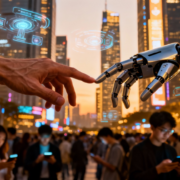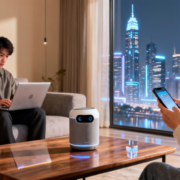

人工智能正以前所未有的速度融入我们的生活,从智能家居到医疗诊断,它带来了极大的便利。然而,我们也越来越依赖这项技术。本文将深入探讨AI如何改善日常效率、塑造工作模式,并揭示我们对其日益增长的依赖。
AI驱动的生活便利
Artificial intelligence has seamlessly woven itself into the fabric of our daily routines, turning what once required conscious effort or time-consuming decisions into effortless experiences. At the heart of this transformation lies a suite of technologies that operate quietly in the background—voice-controlled devices like Amazon Echo and Google Home, recommendation algorithms on platforms such as Netflix and Spotify, and smart thermostats like Nest—that collectively redefine convenience. These tools are not mere novelties; they represent a fundamental shift in how we interact with technology, making life smoother, faster, and more personalized than ever before.
Consider the humble voice assistant: no longer just a novelty for tech enthusiasts, it has become a central hub for managing household tasks. With a simple command like “Hey Google, turn off the lights,” users can control their environment without lifting a finger. This isn’t just about automation—it’s about reducing friction. When you’re tired after work, cooking dinner, or simply trying to enjoy a moment of relaxation, the ability to manage your home through natural language interaction eliminates the need to physically engage with devices. It creates a space where attention is preserved for what truly matters, rather than being siphoned off by mundane chores.
Similarly, AI-driven recommendation systems have redefined how we consume media, shop, and discover new content. Platforms like YouTube, TikTok, and Amazon use sophisticated machine learning models to analyze user behavior—what we watch, click, buy, and even how long we linger on certain items—to predict future preferences. This isn’t guesswork; it’s pattern recognition at scale. For instance, if you’ve watched several documentaries about climate change, the algorithm will likely surface related content, products, or news articles tailored to your interests. In online shopping, this means fewer irrelevant clicks, quicker decision-making, and a higher likelihood of finding exactly what you’re looking for—sometimes before you even know you wanted it. The result? A curated experience that feels intuitive and deeply personal, saving hours of browsing and filtering.
Smart thermostats exemplify another layer of AI integration—one that combines energy efficiency with behavioral adaptation. Devices like Nest learn from your schedule, temperature preferences, and even occupancy patterns to automatically adjust heating and cooling settings. If you typically leave the house at 8 a.m., the thermostat knows to reduce energy usage during those hours. If it detects unusual activity (like someone staying up late), it might adapt accordingly. Over time, these systems optimize comfort while minimizing waste, which benefits both the consumer and the planet. They don’t just react—they anticipate. That predictive capability is what makes them feel less like gadgets and more like intelligent companions embedded in our homes.
What’s remarkable is how these conveniences have become so normalized that many people now struggle to imagine life without them. There’s an invisible dependency forming—not because we must rely on AI, but because it has made certain tasks so easy that doing them manually feels inefficient. This isn’t inherently negative; in fact, it liberates time and mental bandwidth for creative pursuits, family, or rest. But it also signals a deeper trend: as AI becomes more embedded in routine activities, our expectations of convenience rise, and our tolerance for inefficiency shrinks. We begin to expect instant answers, seamless transitions between tasks, and hyper-personalized services. This normalization creates a feedback loop where each new convenience raises the bar for the next, reinforcing our reliance on AI-powered solutions.
This growing dependence is not limited to individual habits—it shapes societal norms around productivity, accessibility, and quality of life. As more households adopt AI-enhanced appliances and digital assistants, disparities emerge: those who can afford these tools gain incremental advantages in time management and comfort, while others remain tethered to older, slower methods. Yet despite these concerns, the core value remains undeniable—the ability to reclaim time and reduce cognitive load through intelligent automation. Whether it’s ordering groceries via voice command, having your playlist evolve based on your mood, or letting your home regulate itself, AI doesn’t just make things easier—it changes how we perceive effort, time, and personal agency in everyday life.
工作场所的AI变革
In the modern workplace, artificial intelligence is no longer a futuristic concept—it is a present-day force reshaping how we work, what we produce, and how decisions are made. Across industries such as healthcare, finance, manufacturing, and customer service, AI systems are automating repetitive tasks, optimizing complex workflows, and enabling data-driven decision-making at a scale previously unimaginable. These transformations have brought undeniable benefits: increased efficiency, reduced human error, and the ability to focus on higher-value cognitive work. But they also come with a growing dependency that raises questions about autonomy, skill erosion, and the long-term structure of professional life.
Take healthcare, for example. AI algorithms now assist radiologists by analyzing medical images—such as X-rays, MRIs, and CT scans—to detect anomalies like tumors or fractures with accuracy rivaling or exceeding human experts. This doesn’t just speed up diagnosis; it allows doctors to spend more time with patients and less time poring over images. In surgical settings, robotic assistants guided by AI help surgeons perform minimally invasive procedures with greater precision, reducing recovery times and complications. Yet this reliance introduces new risks: if clinicians become too dependent on AI outputs without understanding their underlying logic, diagnostic errors may go undetected when the system fails—or worse, when it’s biased due to unrepresentative training data. The danger lies not in the technology itself but in the loss of critical judgment that comes from over-trusting automated suggestions.
In finance, AI has revolutionized everything from fraud detection to portfolio management. Machine learning models can process millions of transactions per second, identifying suspicious patterns indicative of money laundering or credit card fraud far faster than any human team could. Investment firms use AI-powered platforms to analyze market trends, news sentiment, and historical performance to recommend asset allocations tailored to individual risk profiles. While these tools enhance responsiveness and reduce operational costs, they also create vulnerabilities. Algorithmic trading bots, for instance, can trigger flash crashes when multiple systems react identically to minor market fluctuations—a phenomenon seen in 2010 when the Dow Jones dropped nearly 1,000 points in minutes. Moreover, financial institutions increasingly rely on opaque “black box” models whose internal reasoning is inaccessible even to senior analysts, raising concerns about accountability when things go wrong.
Manufacturing has perhaps seen one of the most visible transformations through AI integration. Smart factories now use predictive maintenance powered by AI to monitor machinery health in real time, forecasting failures before they occur. This reduces downtime, optimizes supply chains, and cuts waste. For example, General Electric uses AI to analyze sensor data from jet engines, allowing them to schedule repairs only when necessary rather than adhering to fixed maintenance schedules. Similarly, AI-driven quality control systems inspect products using computer vision, catching defects invisible to the naked eye. However, this automation often leads to job displacement—not necessarily because humans are replaced entirely, but because roles evolve into oversight positions requiring technical fluency. Workers who once operated machines now must interpret AI-generated insights, manage exceptions, and collaborate with intelligent systems. Those lacking access to reskilling opportunities risk being left behind, deepening socioeconomic divides within industrial economies.
Customer service offers another compelling case study. Chatbots and virtual agents powered by natural language processing now handle routine inquiries—password resets, order tracking, billing issues—freeing human representatives to address complex problems that require empathy and nuance. Companies like Amazon, Apple, and banks worldwide deploy AI assistants that learn from millions of interactions to improve responses over time. This leads to faster resolution times, 24/7 availability, and consistent service quality. But here too, there’s a cost: customers may feel alienated when interacting with systems that fail to grasp context or emotional tone. Worse, organizations that outsource too much to AI risk losing the human touch that builds brand loyalty. There’s also the issue of data privacy—AI systems require vast amounts of personal information to function effectively, and misuse or breaches can erode public trust.
What makes this transformation particularly profound is its dual nature: it simultaneously empowers and constrains. On one hand, AI enables professionals to offload mundane tasks, freeing mental bandwidth for creative problem-solving, strategic planning, and innovation. On the other, it creates a feedback loop where workers begin to expect AI to do more, gradually relinquishing the skills needed to operate independently. A software engineer might stop writing code manually because an AI copilot writes it for them, leading to a generation of developers who can’t debug their own programs. A manager might defer all strategic choices to an AI dashboard, forgetting how to assess trade-offs based on experience rather than data alone.
This growing dependence isn’t merely a technological shift—it’s a cultural one. As AI becomes embedded in our professional routines, we must ask: Are we building smarter tools, or are we becoming less capable ourselves? The answer depends on how we design, implement, and govern these systems. Without deliberate efforts to maintain human oversight, foster continuous learning, and ensure ethical deployment, the convenience AI brings in the workplace could ultimately undermine the very qualities that make us uniquely effective in professional environments: adaptability, intuition, and moral reasoning.
依赖AI的风险与伦理考量
As artificial intelligence becomes increasingly embedded in our daily routines—from personalized recommendations on streaming platforms to voice assistants managing our calendars—it brings undeniable convenience. We wake up to AI-curated news summaries, navigate traffic using real-time route suggestions, and receive tailored health advice based on wearable data. These tools streamline decision-making, reduce cognitive load, and often feel like invisible helpers that anticipate our needs before we even articulate them. In this way, AI has evolved from a futuristic concept into a seamless part of modern life, offering time savings, improved accuracy, and unprecedented access to information.
Yet, beneath the surface of these efficiencies lies a growing dependency that reshapes how we think, act, and relate to one another. The very features that make AI so useful—its speed, consistency, and ability to process vast amounts of data—are also what make it dangerously seductive. When we outsource routine decisions to algorithms, such as choosing what to eat, where to travel, or which job to apply for, we begin to lose the muscle of critical thinking. Over time, this can lead to what researchers call “cognitive offloading,” where humans rely so heavily on external systems that they stop practicing judgment, creativity, and problem-solving independently. It’s not just about forgetting how to calculate a tip; it’s about losing the capacity to evaluate complex situations without an algorithmic crutch.
This dependency extends beyond individual habits into broader societal structures. In education, students increasingly use AI tutors to complete assignments, sometimes bypassing the learning process entirely. In healthcare, doctors may defer to diagnostic algorithms without questioning their logic or limitations—a trend that risks turning clinical expertise into passive interpretation. Even in personal relationships, apps now suggest messages, predict emotional responses, and manage social interactions through chatbots. While these innovations enhance accessibility and efficiency, they also create a feedback loop: the more we rely on AI, the less we develop the skills needed to function autonomously when those tools fail—or worse, when they are manipulated.
The risks deepen when we consider job displacement. Unlike previous technological shifts, AI doesn’t just automate manual labor—it targets cognitive tasks once considered uniquely human. For example, legal professionals are using AI to draft contracts, journalists employ automated writing tools for basic reporting, and financial analysts depend on predictive models for investment strategies. While some jobs evolve rather than disappear, many workers find themselves obsolete overnight, especially those without access to reskilling opportunities. This creates a two-tiered society: one where tech-savvy individuals thrive in AI-augmented roles, and another where displaced workers face economic precarity, resentment, and social fragmentation.
Privacy concerns further compound the issue. Every interaction with AI—whether it’s a smart speaker listening in the background or a fitness tracker sharing biometric data—contributes to massive datasets used to train and refine machine learning models. Often, users don’t fully understand how their data is collected, stored, or monetized. Worse still, these systems can be exploited by malicious actors who manipulate algorithms to influence behavior, spread misinformation, or conduct surveillance at scale. The lack of transparency around how AI makes decisions—especially in high-stakes domains like hiring, lending, or law enforcement—means people are frequently judged by opaque systems they cannot challenge or comprehend.
Ethical dilemmas abound. Algorithmic bias, for instance, arises when training data reflects historical inequalities, leading AI systems to perpetuate discrimination against marginalized groups. A well-documented case involved facial recognition software that misidentified Black faces at significantly higher rates than white ones, resulting in wrongful arrests. Similarly, credit scoring algorithms have been shown to disadvantage low-income communities by relying on proxies like location or shopping patterns that correlate with socioeconomic status. These biases aren’t accidental—they’re systemic, stemming from flawed design choices, inadequate oversight, and a lack of diverse representation in development teams.
Transparency and accountability remain elusive. Most AI systems operate as black boxes: inputs go in, outputs come out, but the reasoning behind them is hidden. This opacity undermines trust and prevents meaningful redress when things go wrong. If an AI denies someone a loan or flags them as a security risk, how do they know why? How do they appeal the decision? Without clear mechanisms for accountability, responsibility diffuses across developers, companies, regulators, and end-users—an arrangement that leaves individuals vulnerable and institutions unaccountable.
To mitigate these risks, we must move beyond reactive fixes toward proactive governance. First, ethical AI frameworks need to be codified into law—not merely as guidelines but as enforceable standards. Governments should mandate algorithmic impact assessments for high-risk applications, requiring developers to demonstrate fairness, explainability, and robustness before deployment. Second, public institutions must invest in digital literacy programs that teach citizens how to critically engage with AI—not just use it, but understand its limitations and implications. Third, corporations must prioritize inclusive design practices, ensuring diverse teams shape the development process from the outset. Finally, independent auditing bodies should monitor AI systems post-deployment, holding organizations accountable for unintended consequences.
Ultimately, the path forward isn’t about rejecting AI—it’s about redefining our relationship with it. We must resist the temptation to treat AI as a panacea while acknowledging its potential to amplify both human strengths and flaws. By embedding ethics into the core of AI development, fostering transparency, and empowering individuals with knowledge and agency, we can build a future where technology serves humanity—not the other way around.
未来:人机协作的新范式
The integration of artificial intelligence into our daily lives has evolved from a futuristic concept to an everyday reality, and the most profound shift isn’t just in what AI does—it’s in how it changes the nature of human agency. We’ve moved beyond passive consumption of AI tools—like smart assistants or recommendation engines—to a more dynamic, reciprocal relationship where humans and machines co-create value. This new paradigm, often referred to as augmented intelligence, represents not a replacement of human capabilities but an amplification of them. It’s about leveraging AI not to make decisions for us, but to empower us to think deeper, act faster, and innovate more boldly.
Consider the medical field: radiologists no longer simply interpret scans; they work alongside AI systems that flag anomalies invisible to the naked eye, allowing doctors to focus on complex cases rather than routine screenings. In education, AI tutors personalize learning paths based on student performance, freeing teachers to engage in mentorship and critical thinking exercises instead of grading multiple-choice tests. In creative industries—from music composition to graphic design—AI tools don’t write songs or generate images autonomously; they serve as collaborators, offering suggestions, automating repetitive tasks, and enabling artists to explore ideas that would have been too time-consuming or technically demanding otherwise.
This collaborative model hinges on a fundamental rethinking of roles: humans provide context, intention, empathy, and ethical judgment—qualities that AI cannot replicate. AI, in turn, handles pattern recognition at scale, data processing, and predictive modeling with precision far beyond human capacity. The result is a symbiosis where each party compensates for the other’s limitations. For example, in climate science, researchers use AI to simulate thousands of scenarios based on vast datasets, then apply their domain expertise to interpret results, prioritize interventions, and advocate for policy changes grounded in both evidence and values.
Yet this vision of collaboration doesn’t emerge automatically—it must be cultivated. Education systems must evolve to teach not just coding or data literacy, but also how to collaborate effectively with intelligent systems. Students need to learn how to ask the right questions of AI, evaluate its outputs critically, and understand when to trust or challenge its recommendations. Policymakers, meanwhile, must ensure that infrastructure supports equitable access to these tools—not just for tech hubs, but for rural schools, small businesses, and underserved communities. Without such investments, we risk reinforcing existing inequalities under the guise of progress.
Public awareness is equally crucial. People must move beyond fear-based narratives—either of AI replacing all jobs or of being enslaved by algorithms—and embrace a mindset of co-evolution. This means recognizing that AI is a tool, like fire or electricity, whose impact depends entirely on how we wield it. A well-informed public can demand transparency in algorithmic decision-making, push for accountability when systems fail, and participate in shaping norms around responsible innovation. It also means fostering digital citizenship—where individuals understand their rights, responsibilities, and opportunities in an AI-augmented world.
What makes this future particularly promising is that it doesn’t require perfect technology or flawless governance. It requires a cultural shift—a willingness to see AI not as a competitor but as a partner in solving humanity’s greatest challenges. Whether it’s designing sustainable cities, advancing scientific discovery, or building inclusive economies, the path forward lies in harnessing the unique strengths of both humans and machines. And if we get this right, the next chapter won’t be about control or dependency—it will be about empowerment, creativity, and shared purpose.
Conclusions
人工智能在提升效率和便利性方面功不可没,但也引发了对人类依赖性的担忧。我们需要在享受技术红利的同时,保持批判性思维,确保AI的发展服务于人类福祉而非取代人类判断。